Researchers at INEGI have been making excellent progress on aspects of the FLASH-COMP inspection and monitoring solution (FLASH-IM), developing methods for bubble detection and flow front monitoring during resin infusion that combine easy to access technologies with state-of-the-art AI algorithms. Come and see them present their progress at the upcoming EFFRA Manufacturing Partnership Days on 7-8 May 2024.

A common drawback of liquid-resin-based manufacturing processes is that it if the fibre laminates are not properly placed, their quality is not optimal, or resin does not flow as expected, defects can occur, often manifesting as bubbles or dry spots. Air trapped within the resin and inserted into the parts can produce or potentiate the generation of such defects. These defects can be reduced by introducing excess resin, but this leads to two issues: waste within the infusion and finishing process, and a tedious and expensive quality control loop after the part is finished.

To counteract this, a goal of the project has been to create a bubble detection and a flow front monitoring system,to monitor the bubbles on the resin lines and monitor the advancement of the resin. While working on this part of the FLASH-COMP solution, the researchers initially found it more difficult than expected. The proposed linear camera’s technological limitations meant it could only be used for some specific monitoring applications, and it was only once they started using a matrix camera – a common and affordable piece of equipment – that they began to have some success. “It was a real headache for us at first,” says Carlos Rocha Ferreira of INEGI. “One of the main purposes of the project is to have a system that automatically provides details about the quality of infusion by monitoring the progress of the resin, and it was only once we started using this matrix camera that we were able to overcome the problems we found in doing this.”

Video of an infusion performed during testing

Flow front tracking example with graphic showing the percentage of the mould area filling

Another flow front tracking example with graphic showing the percentage of the mould area filling

Tiago Rodrigues of INEGI adds: “The fact that the matrix camera is a very common technology is a real plus for us as it makes the whole solution a lot more accessible and affordable. All that we have added is some clever AI systems and detection technologies. Information from this system can now be used for active control strategies for the infusion process. We can see when the resin is not flowing properly, which often leads to defect formation, and then based on this information we can apply corrective strategies to improve the infusion process.”

During the infusion process, one of the main aspects which is monitored is the flow front. As resin is injected into the mould, it moves like a wave from one side of the mould to the other, so there is always a physical boundary between the wet and the dry parts of the mould. In FLASH-COMP, the researchers use cameras to track where this limit is, and combine this with information from simulations that indicates where the flow front should be at any given moment. If there are discrepancies, corrective actions can then be taken. “Here, we are again using the cameras to extract information that allow us to effectively use active control strategies,” says Tiago. “By the end of the project, we hope to have perfected this strategy so that we are able to create parts with zero defects every time.”

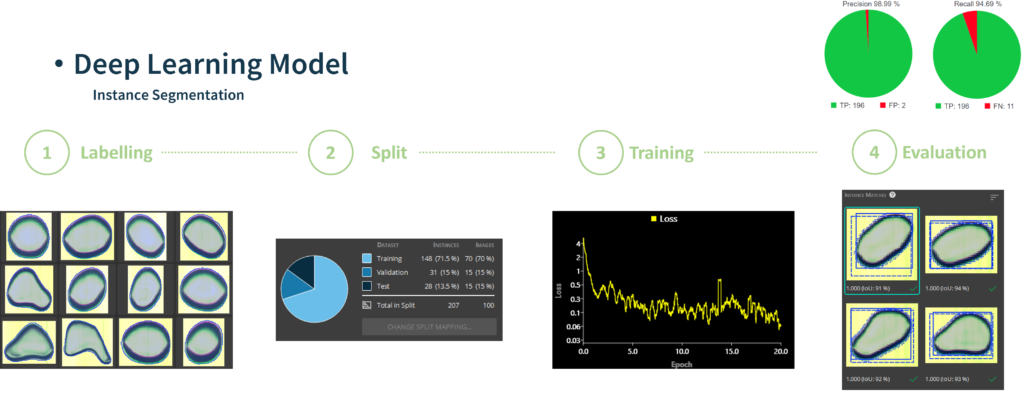
Deep learning model training steps for the AI bubble detection algorithm

Bubble tracking setup; Realtime bubble tracking image with overlay; Bubble count and plotting

Another issue that the FLASH-COMP project is trying to solve is the difficulty of monitoring the infusion process over such a large space: some moulds can be more than 10 metres long. One strategy is to try and monitor the whole thing, but this is very difficult and can only be done at a low resolution. A different strategy, which is currently being pursued in the project, is to try and identify regions of interest where the infusion process can be monitored at higher resolution and that are easy to assess, and are free of obstructions such as the inlets or outlets where resin enters and exits. At the same time, these areas need to be relevant for the process – places where issues with resin infusion are likely to occur.

To identify these regions, the researchers are using a LIDAR system to scan the mould to determine where the clearer areas that are suitable for placing matrix cameras are. They then apply algorithms for stereo vision using the matrix cameras to enable them to gather 3D information from the moulds. Combining this with the information from the scans generates high resolution models that allows them to identify the regions of interest based on an overall coordinate system. This information is then fed into simulations, and data from these simulations is then fed back into the system, creating a loop of information that will help to continuously improve the monitoring of infusion.

The initial work on global monitoring has been a success, using software from one of the partners to identify shapes and forms within the mould. Now, they are looking to switch to using AI systems, leveraging algorithms that will provide even better information, and using Python which will be easier to implement in the final digital testbed. “Our work on bubble tracking is basically complete,” says Tiago. “Regarding the flow front, we are also nearly there, but need to work out how to scale up our strategy. Overall, we are really pleased with how things have progressed so far.”

FLASH-COMP Physical Test Bed

From validation to demonstration: FLASH-COMP clears the path towards zero defect manufacturing for large-scale composites 

Three years after launch, FLASH-COMP has reached a defining moment. The completion and validation of its Physical Test Bed for large composite liquid resin infusion processes confirms pre-industrial integration readiness and opens the door to full industrial demonstration – accelerating the project’s mission to enable the sustainable, zero-defect manufacturing of composite parts.

Read More »